
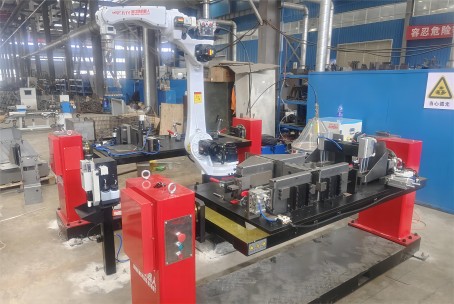
1. Part Preparation and Assembly:
- Strictly control the quality of part preparation to ensure that surface quality, groove dimensions, and assembly accuracy meet welding requirements.
- Develop welding procedures specifically for robots, with strict process specifications for part dimensions, weld grooves, and assembly tolerances.
- Utilize high-precision assembly tooling to enhance the assembly accuracy of weldments and ensure effective seam tracking.
2. Weld Preparation:
- Welds should be cleaned thoroughly, free of oil, rust, spatter, slag, and other debris. Weldable primer is permissible.
- Change tack welding from electrode welding to gas-shielded welding, and grind the tack points to prevent residual slag or porosity from affecting the final weld quality.
3. Welding Process Contrquip the system with seam tracking tools to ensure the welding torch follows the joint during operation, maintaining a constant distance between the torch and the workpiece.
- Utilize the robot’s intelligent welding system. Use offline programming to preset the robot’s motion trajectory, torch posture, welding parameters, etc., ensuring consistent parameters and stable weld quality.
4. Weld Quality Inspection:
- After cooling, operators can visually inspect the weld for proper fill. A well-formed weld typically has its surface slightly higher than the base material, with smooth and aesthetically pleasing ripple patterns.
- Employ non-destructive testing methods (such as radiographic inspection, magnetic particle inspection, etc.) for penetration testing to assess the rework rate and ensure weld quality.
5. Robot Performance and Maintenance:
- Ensure the welding robot possesses high stability, precision, and longevity. This involves considerations in structural design, control system design, and the drive precision of the power system.
- Perform regular maintenance and servicing on the robot to guarantee its normal operation and long-term stability.
6. Personnel Training and Operating Specifications:
- Provide training for operators and maintenance personnel to familiarize them with robot operation and maintenance procedures.
- Develop detailed operating specifications and maintenance manuals to ensure personnel adhere to established procedures.
7. Continuous Improvement and Innovation:
- Continuously collect and analyze data from the welding process to identify and improve factors affecting weld quality.
- Stay informed about technological and process advancements within the industry and actively introduce new techniques and technologies to enhance welding quality.
By following the steps and strategies outlined above, the workpiece quality of welding robots can be ensured, leading to improved welding efficiency and stability.
Post time: Mar-20-2026