
 Date: June 12, 2026
In the field of automated welding, many manufacturers focus solely on the brand and specifications of the robot arm when upgrading their equipment. However, at JHY Robotic, we understand a fundamental industry truth: a high-output, high-quality welding system is defined not just by the robot, but by the seamless integration of the welding positioner and fixtures.
The synergy of these three components is the key to defining the competitiveness of a modern smart factory.
1. The Power of Synchronization: Robot + Positioner A standard welding robot is limited by its reach and degrees of freedom. By integrating a welding positioner, you essentially add external axes to the robot. This combination allows the workpiece to be flipped and rotated, ensuring the weld seam is presented to the torch in the optimal position (flat or horizontal) at all times. This technology, known as “Positioner-Robot Coordinated Motion,” is crucial for workpieces with complex structures and variable 3D trajectories. It eliminates welding dead zones caused by the robot’s posture limitations and fundamentally ensures consistent weld quality.
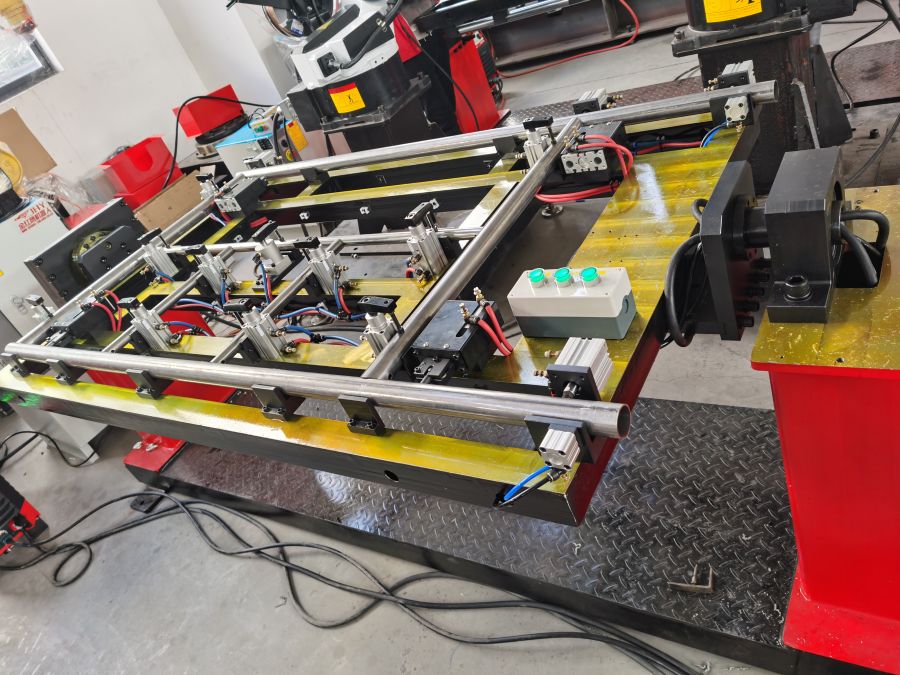
2. Fixtures: The “Hidden Champion” of the System If the robot and positioner are the muscles and bones, the fixture is the central nervous system. It plays an indispensable role: Rigid Support & Anti-Deformation: Welding generates heat and thermal stress. High-precision custom fixtures increase the rigidity of the workpiece, suppressing deformation caused by heat and ensuring final dimensional accuracy. Maximizing Efficiency: Excellent fixture design supports rapid changeovers. Combined with pneumatic or hydraulic clamping systems, it drastically reduces non-cutting auxiliary time, keeping the robot welding continuously and maximizing production capacity. Quality Stability: Fixtures eliminate the randomness of manual placement. They ensure that every workpiece is held in the exact same position, guaranteeing the reusability of programmed paths and significantly reducing scrap rates.
3. Expanding Capabilities and ROI By utilizing different types of positioners and fixture designs, a single stationary robot can gain “versatile” capabilities. For example, in JHY Robotic’s solutions, we use dual-station positioners with quick-change fixtures, allowing customers to alternate between different product specifications on the same robot. This “one machine, multiple uses” strategy greatly expands the processing range and maximizes your Return on Investment (ROI).
4. The JHY Robotic System Integration Advantage We do not just sell robots; we provide turnkey solutions. Our strength lies in customizing solutions based on your specific components: Heavy-Duty Gantry Systems: Combining large dual-axis positioners with strong support fixtures for massive steel structures. Precision Welding Workcells: Utilizing high-precision servo positioners and zero-gap locating fixtures for sheet metal parts. Non-Standard Customization: Designing dedicated multi-station turntables and pneumatic clamping solutions for irregularly shaped parts. Conclusion To achieve true automation, you must look beyond the robot arm itself. Stable welding positioners and intelligent fixture design are what transform a simple robot into a high-efficiency production engine. Wuxi JiHoyen is committed to providing you with integrated “Robot + Positioner + Fixture” solutions to fulfill our vision: “Enables every factory to use good robots.”
About Wuxi JiHoyen Industrial Automation Co., Ltd. Founded in 2011 and rooted in the welding industry since the 1990s, Wuxi JiHoyen (JHY Robotic) is a high-tech enterprise specializing in the R&D, manufacturing, and system integration of industrial robots and automated welding solutions. We focus on providing reliable robotic welding systems, positioners, fixtures, and turnkey automation projects for factories worldwide. Original source: www.jhyrobotic.com
Post time: Jun-12-2026