
Release Date: July 30, 2026
By: JHY/Baykal Robotics Global Export Division
As global manufacturing faces mounting pressure from skilled welder shortages, rising labor costs, and tightening quality standards, international buyers are increasingly turning to robotic welding systems. Yet one of the most frequently asked questions we receive from our overseas clients is: “What does a welding robot actually cost, and what am I paying for?”
As a direct welding robot manufacturer serving global markets, we believe transparency in pricing structure is critical for overseas buyers planning capital investment. This article outlines the current global price landscape of welding robots in 2026, explains the core factors influencing total robot system cost, and provides guidance on which price tier fits different industrial applications.
1. General Welding Robot Price Ranges in the Global Market (2026)
Welding robot pricing varies significantly depending on whether you are purchasing a bare robot arm, a semi-integrated robot cell, or a full turnkey automated welding robot line. Based on 2026 export market data and our own international project experience, the typical cost brackets are:
1.1 Entry-Level / Economic Robotic Systems (USD $9,000 – $35,000)
Usually refers to a single 6-axis robotic arm (payload 3–10 kg) or a basic complete robot set with a standard MIG welding equipment (basic welding power source,welding torch and wire feeder). Ideal for first-time automation adopters and small workshops. Robot arms alone in this tier from Asian manufacturers can start around $9,000–$20,000, while a basic robot workstation may land near $25,000–$35,000.
1.2 Mid-Range Industrial Welding Robot Cells (USD $25,000 – $80,000)
The most common choice for SMEs and metal fabrication shops. Includes a 6–20 kg industrial welding arm, digital welding source, 1-axis or 2-axis positioner, safety fencing, and basic integration. Chinese-brand complete robot cells often range $25,000–$80,000, whereas similar Japanese/European configurations can exceed $100,000.
1.3 High-End / Customized Turnkey Systems (USD $80,000 – $200,000+)
Except for robot arm with welding equipment, these aspects also effect much on the total cost like laser seam tracking, vision systems, multi-robot coordination, offline programming, fume extraction, and full safety compliance (CE/ISO). Common in automotive, heavy equipment, and structural steel industries.
1.4 Large-Scale Automated Welding Lines (USD $200,000 – $1,500,000+)
Fully integrated production lines with conveyors, gantries, intelligent inspection, and MES connectivity. Typically deployed by tier-1 automotive OEMs, shipbuilders, and energy infrastructure manufacturers.
Manufacturer Note: Many overseas buyers initially compare only “robot arm prices.” In reality, the arm itself typically accounts for only 30%–40% of total system cost. The remaining 60%–70% lies in welding equipment, positioners, tooling, safety, software, and integration labor.
2. Key Factors Influencing Welding Robot Prices for Overseas Buyers
Understanding what drives cost helps international purchasers evaluate quotes more accurately and avoid hidden expenses.
A. Brand Origin and Certification
Global premium brands (ABB, FANUC, KUKA, Yaskawa) carry a 30%–80% price premium over comparable Asian-made models due to brand equity, R&D, and worldwide service networks.
Certifications matter for export: Systems destined for Europe or North America often require CE, UL, or ISO 10218 compliance, which adds cost in components, documentation, and testing.
B. Payload, Reach, and Axis Configuration
Higher payload (≥20 kg) and longer reach (≥2000 mm) require larger motors, reinforced structures, and higher-precision reducers, increasing arm cost by 30%–60% compared to standard 6 kg / 1400 mm models.
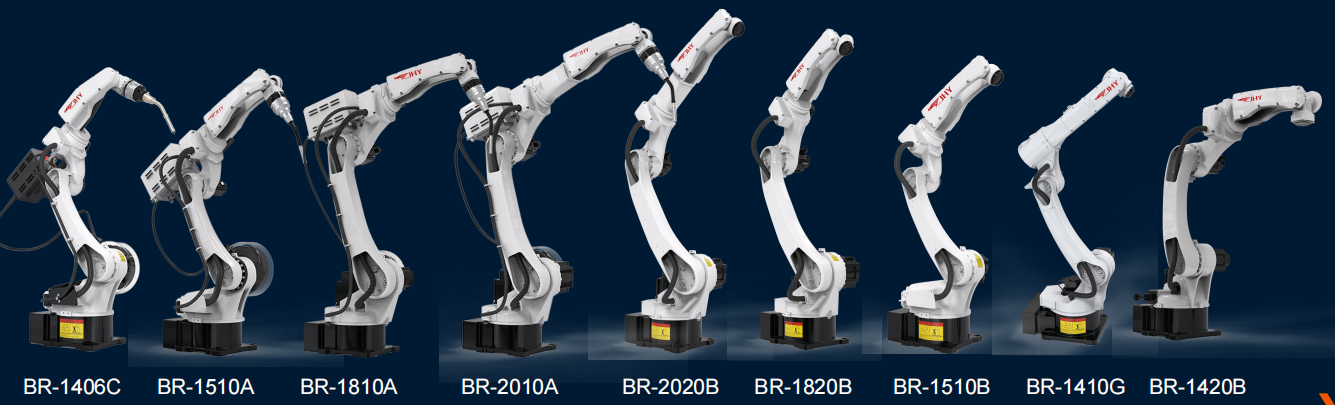
Additional axes (7-axis, external linear tracks, or dual-arm setups) add both hardware and programming complexity.
C. Welding Process and Power Source
MIG/MAG welding systems are the most cost-effective.
TIG welding adds $3,000–$5,000+ for precision torch control and wire feeding.
Laser welding systems can be 2–3× more expensive than conventional arc welding due to laser sources and optical components.
Premium power sources (Fronius, SAF,Lorch, ESAB, Lincoln, Miller) increase cost but improve arc stability and weld quality—often preferred by overseas buyers in high-spec markets.
D. Intelligence: Sensing and Software
Basic touch-sensing is usually included.
Laser seam tracking ($5,000–$15,000) and vision-guided systems ($8,000–$20,000) significantly improve performance on irregular parts but raise the budget.
Offline programming software and simulation tools add $3,000–$20,000 but reduce onsite commissioning time—valuable for overseas projects with limited integrator presence.
E. Integration Scope and Peripheral Tooling
A floor-standing robot is cheaper than a cell with servo positioners, custom fixtures, automatic tool changers, fume extraction, and light-curtain safety enclosures.
High-quality custom fixtures are often underestimated; poor tooling leads to rework and downtime. Fixture costs can range from $10,000 to $50,000+ depending on complexity.
F. Logistics, Duties, and After-Sales Support
International shipping, insurance, import duties (varying by region, often 5%–20%), and local compliance documentation affect total landed cost.
Remote commissioning support, spare parts availability, and training (adding $5,000–$20,000 per system) are critical for overseas buyers with limited local technical resources.
3. Summary: Which Price Tier Fits Which Application?
From a manufacturer’s perspective, matching budget to actual production needs ensures the best ROI for overseas buyers.
Price Tier (Complete System Est.) Typical Configuration Best-Suited Applications & Buyers
$9,000 – $30,000 Basic 6-axis arm or simple cell, manual clamping, MIG only Small metal workshops, simple brackets, repetitive short seams, entry-level automation in developing markets
$25,000 – $80,000 Mid-range arm (6–20 kg), single/dual-axis positioner, safety fence, standard synergic welder General metal fabrication, automotive component suppliers, agricultural machinery, elevator panels, SMEs scaling production
$80,000 – $200,000 High-payload or high-speed arm, laser/vision tracking, servo positioner, fume extraction, offline programming Heavy structural steel, construction machinery, thick-plate welding, high-mix job shops requiring flexibility, precision TIG/laser applications
$200,000 – $1,500,000+ Multi-robot cells, gantry systems, conveyor integration, MES connectivity, full line safety Automotive body-in-white, shipbuilding blocks, railway vehicles, energy pipelines, large OEM mass-production lines
Closing Perspective from the Manufacturer
For overseas buyers, the “right” welding robot is not necessarily the cheapest nor the most expensive—it is the system whose total cost of ownership (TCO), including integration, consumables, maintenance, and productivity gains, aligns with your production volume and quality requirements.
As a welding robot manufacturer, we advocate for transparent specification comparison rather than arm-only price shopping. We recommend international purchasers request weld samples, clarify scope of supply (arm vs full cell), confirm certification needs early, and evaluate local support feasibility before finalizing procurement.
For tailored configuration advice or a detailed cost breakdown based on your parts and local standards, contact JHY/ Baykal ’s export engineering team today.
Post time: Jul-30-2026